No Drawing. No Replacement. Just an Old Pickguard to Work From.
When a replacement pickguard does not exist and no factory drawing can be found, the worn original part can become the template for an accurate new one.
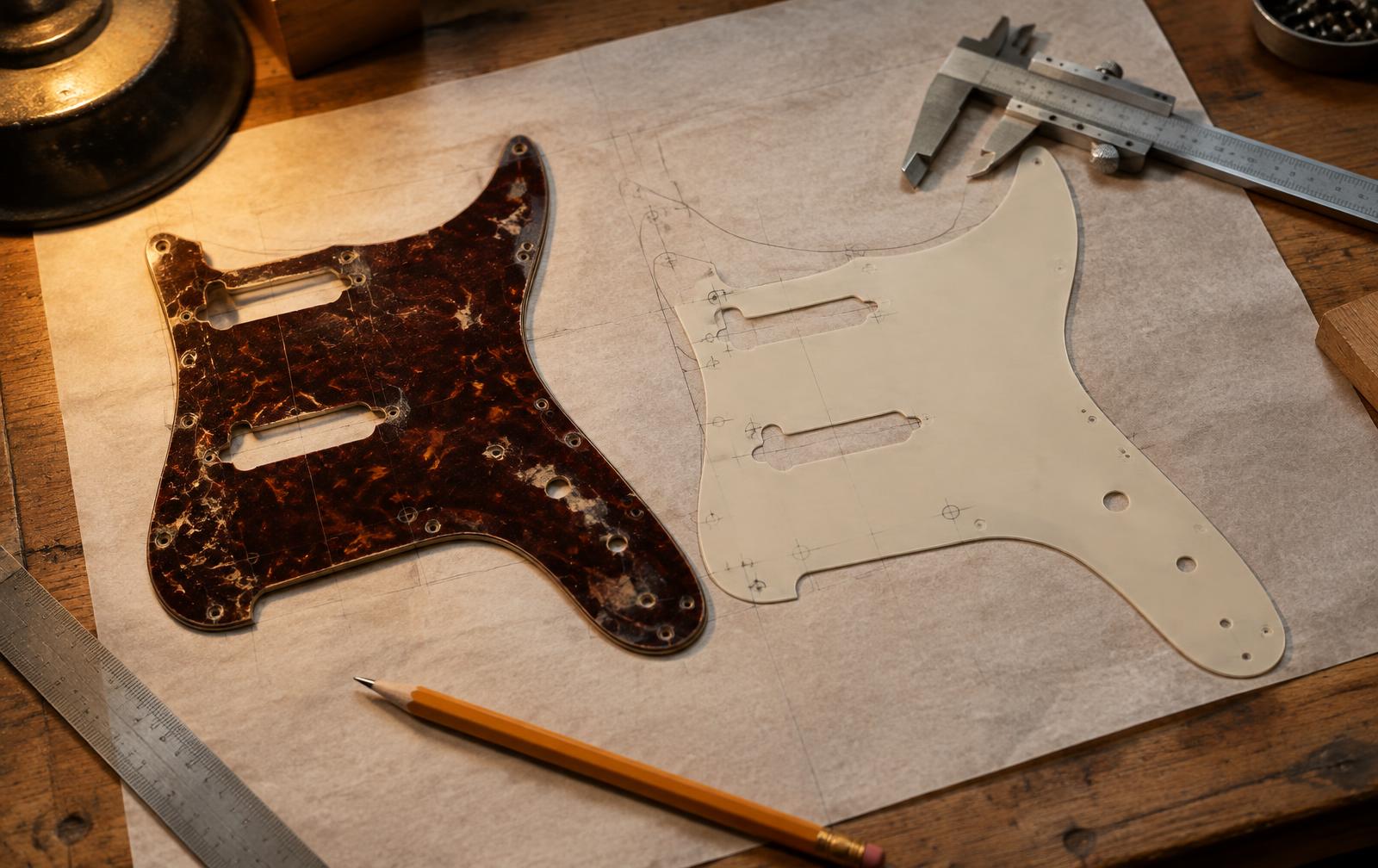
The guitar still plays. The electronics still work. The only problem is the pickguard: cracked, warped, yellowed, or cut for a pickup that disappeared years ago.
You search the model number and find nothing. The manufacturer no longer supports it. No replacement supplier lists the shape. There is no downloadable drawing waiting to be sent to a cutter.
There is only the old pickguard on the guitar—and that may be exactly what is needed.
The Original Part Contains the Missing Information
An old guard is more than worn plastic. It is a physical record of the guitar. Its perimeter shows the body shape it was built around. Its neck pocket, bridge clearance, pickup routes, control holes, and screw locations show where every important feature belongs.
Even damage can be interpreted. A broken corner may still leave enough of the surrounding curves to reconstruct the intended edge. Missing material can be mirrored from a symmetrical area or rebuilt from measurements taken directly from the guitar.
From Physical Part to Digital Outline
The first goal is to capture the guard without perspective distortion. A casual phone photo taken at an angle may look fine, but it changes proportions. The camera should be centered above the part, and a known measurement must appear in the same plane.
For the most dependable result, the original guard can be traced or photographed in a controlled setup. The outline is converted into a digital path, then checked against real dimensions. Openings and screw holes are measured separately rather than assumed from the outside shape.
This is the problem that led our small pickguard shop to develop PartSketcher: we needed a practical way to turn a physical part into usable geometry when no drawing existed.
Tracing Is More Than Following the Edge
Old parts are rarely perfect. Heat and screw pressure can warp thin material. Hand-cut modifications may leave uneven openings. A chipped area may no longer represent the original line. Blindly copying every flaw would reproduce the damage instead of replacing the part.
A useful replacement drawing separates intentional geometry from wear:
- Smooth curves should remain smooth.
- Straight edges should be corrected rather than copied as a wobble.
- Screw holes must match the guitar, even if the old guard has enlarged around them.
- Pickup and control openings should suit the hardware that will be installed now.
- The finished outline must account for the chosen material and cutting method.
Test Before the Final Cut
The digital file should be checked at full size before expensive material or custom artwork is used. A paper, card, or inexpensive test template can reveal a neck-pocket conflict or a misplaced screw hole quickly.
On the guitar, check that the outline follows the body without overhang, every opening clears its hardware, and all mounting points align without forcing the template. This stage is where small corrections are easy.
The Replacement Does Not Have to Look Old
Once the fit is captured, the new guard can preserve the original appearance—or become something completely different. The same traced outline can be cut from a classic solid color, a specialty finish, or a printable surface for custom artwork.
That is one of the advantages of building from the original part. You are not limited to whatever old stock happens to exist. The difficult part—the uncommon shape—becomes a reusable digital template, while the visual finish remains open.
Do Not Throw the Old Guard Away
If your guitar has no listed replacement, keep the damaged guard. Do not trim it further, drill experimental holes, or flatten it with heat. Photograph it before removal and label any unusual hardware positions.
The part that seems worn out may be the only reliable source for the replacement you need. With careful capture, measurement, and verification, it can guide a new pickguard that fits the guitar and gives it another long stretch of playing life.
If you are holding an original guard that no catalog can replace, start a custom pickguard project with PickGuard World. We can work from the part you have and help turn it into the replacement you cannot find.
Featured in this story
Find your next pickguard
Your old part is the starting point
One-Off Replacement Pickguard
When no factory drawing exists, we can trace the original guard and turn its outline and mounting points into a usable cutting file.
Ideal for rare and discontinued guitars
Start a traced replacementKeep the fit, change the look
Custom Artwork & Finishes
Use the newly traced shape with a classic material, specialty pattern, or an image arranged exactly where you want it.
Made from your approved layout
Explore the shop