That Sinking Feeling When Your New Pickguard Almost Fits
The shape looks right, but the screws, pickups, or bridge do not line up. Here is why “almost fits” happens—and how to order a replacement pickguard with confidence.
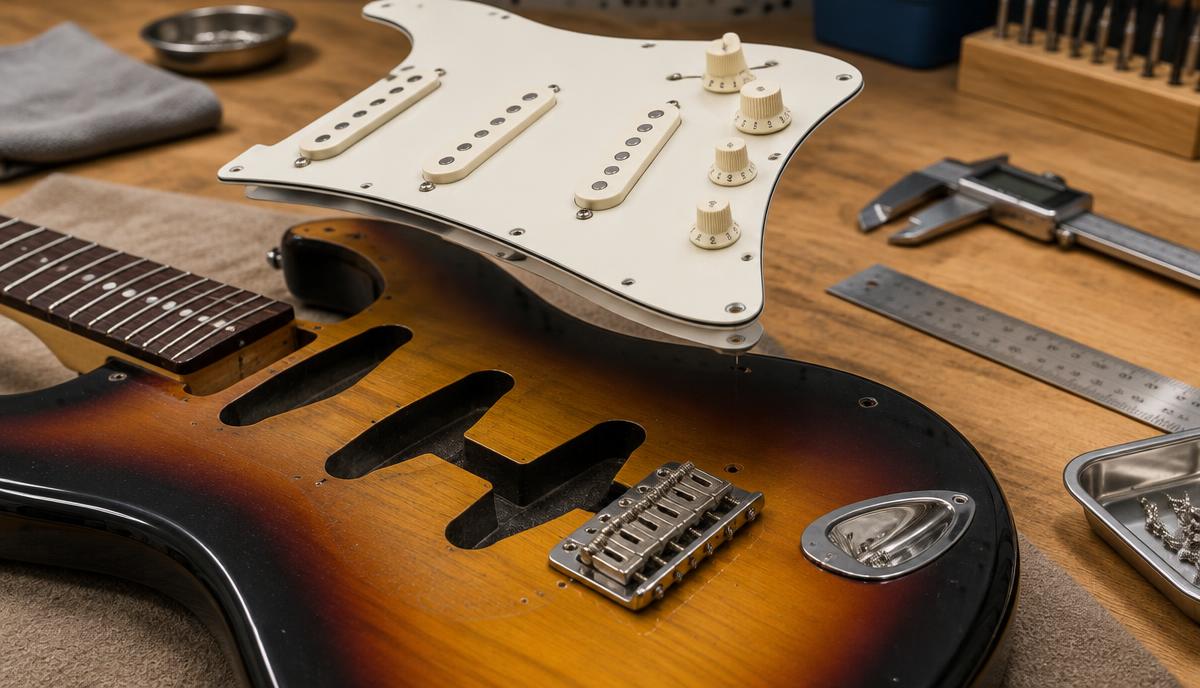
You set the new pickguard over the guitar. The outline looks close. Then one screw hole misses. A pickup opening sits slightly off center. The edge crowds the bridge. It is close enough to make you hopeful and wrong enough to stop the installation.
That is the frustrating reality behind many replacement pickguards: the model name can match while the physical part does not.
Why a Replacement Pickguard Almost Fits
Guitar designs change over time. Factories use different tooling, production locations, hardware, and hole patterns. Two guitars carrying the same familiar model name may have small differences that matter when a rigid part must line up with the body.
Common fit problems include:
- Screw holes that are a few millimeters out of position
- Different numbers or placements of mounting screws
- Pickup routes that do not match the installed pickups
- Bridge, control, or neck openings with different clearances
- A perimeter that meets the body, neck, or hardware incorrectly
- Aftermarket modifications made by a previous owner
Words such as “standard,” “import,” or “vintage style” can help narrow the search, but they do not guarantee that every opening will match your guitar.
Do Not Force an Almost-Fitting Pickguard
If the guard must bend, press against a pickup, or pull sideways to reach the screws, stop before tightening it down. Forcing a poor fit can bow the material, damage the finish, strip a screw hole, or leave the controls under stress.
Drilling a new screw hole may be reasonable in some situations, but only after confirming that the rest of the guard fits correctly and that the new hole will not interfere with a cavity or existing hole. Enlarging pickup or bridge openings by hand can also leave rough edges and still fail to solve the underlying alignment problem.
Compare the New Guard With the Original
The original pickguard is often the best source of fit information. Remove it carefully and compare the two parts directly. Check the full perimeter, every screw location, the neck pocket, pickup routes, controls, and bridge clearance.
Photographs help show the issue, but dimensions or the original physical part provide better information when an accurate replacement is needed. Even a damaged original may preserve enough of the outline and hole locations to create a usable template.
A Better Way to Order a Replacement
Before ordering, identify the exact guitar model, approximate year, production country if known, pickup configuration, and any modifications. When a verified template is unavailable, we can work from the part you already have instead of pretending a generic pattern will fit.
At PickGuard World, the outline and critical openings are checked before the pickguard reaches the laser. That extra step is far easier than discovering a mismatch after the finished design arrives.
A replacement pickguard should not merely look close in a product photo. It should belong on your guitar.
Featured in this story
Find your next pickguard
Measured for your instrument
Custom Replacement Pickguard
When a stock replacement does not line up, we can work from your original guard or verified measurements for a better match.
Fit checked before cutting
Start a custom replacementMore than a generic template
Custom Pickguard Designs
Choose the shape, pickup layout, and finish that suit your guitar instead of settling for the closest catalog option.
Built to order
Explore the shop